
There has long been speculation about the possibility of a U.S. withdrawal from the North Atlantic Treaty Organization (NATO). Should President Donald Trump decide to pull the U.S. out of NATO, it would be a decision with profound consequences—not just for the United States, but for all member states, including those in Europe. While some argue that NATO is an outdated alliance or too costly for the U.S., the reality is that the benefits of being part of NATO far outweigh the potential downsides.
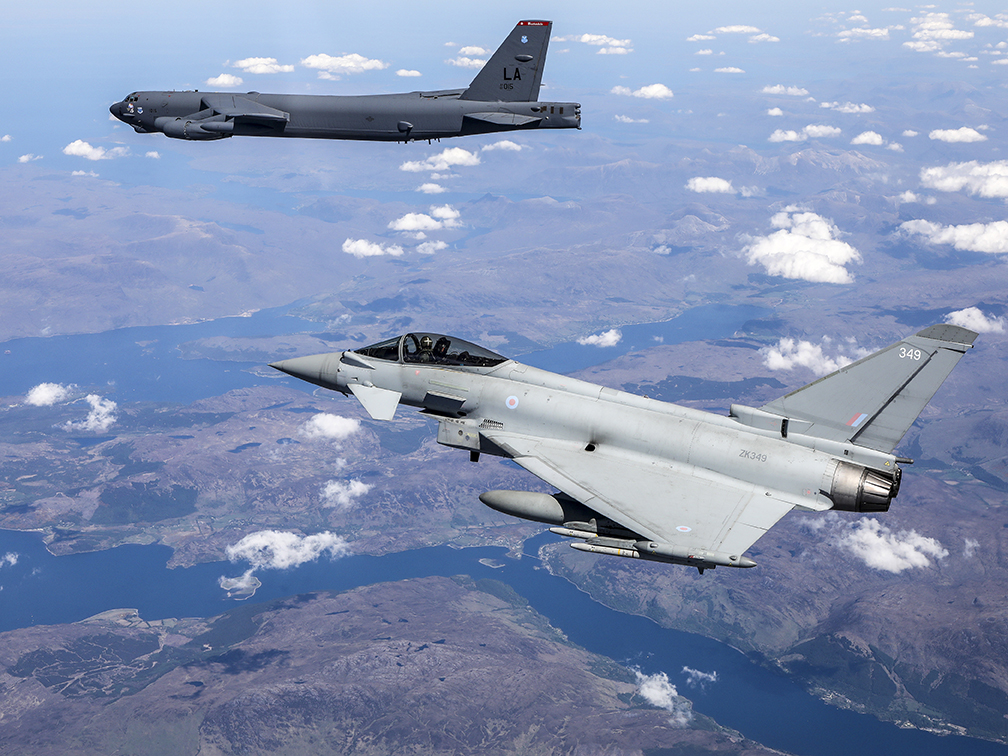
Photo: A B-52H Stratofortress operating out of Morón Air Base, Spain, is escorted by a Royal Air Force Eurofighter Typhoon during the Bomber Task Force Europe mission. Conducting operations with allies and partners in the European theater strengthens interoperability and relationships in the NATO alliance. Photo: Royal Air Force.
First and foremost, NATO provides a critical security framework for the U.S. and its European allies. The alliance is built on the principle of collective defense, enshrined in Article 5 of the NATO treaty: an attack on one member state is considered an attack on all. Without this collective defense guarantee, countries in Europe, especially those near Russia’s borders, would face a more uncertain and dangerous security environment. While NATO’s military presence in Europe has been a source of stability, its dismantling would open the door to increasing instability, particularly with a resurgent Russia.
Europe is simply not equipped to provide for its own defense in the absence of NATO, especially without the U.S. as the cornerstone of the alliance. While France and the United Kingdom maintain nuclear deterrents, their capabilities are relatively modest compared to the vast nuclear arsenal of the U.S. In fact, much of the U.S.’s nuclear stockpile is stored in NATO countries, ensuring a flexible and strategic deterrent. The removal of American nuclear capabilities from these sites would weaken NATO’s overall deterrence, leaving Europe more vulnerable.
A U.S. exit would also have significant ramifications for the defense industry. Currently, NATO’s military operations rely heavily on American materiel—ranging from advanced fighter jets to logistical support and heavy artillery. Should the U.S. depart from the alliance, France and the UK would likely step in to fill the void, relying more on their domestic defense industries. This shift would severely undermine the U.S. defense industry, reducing demand for American-made equipment and potentially eroding American defense capabilities. The financial and technological implications for the U.S. defense sector would be far-reaching, with long-term consequences for American jobs and innovation.
Beyond the economic impacts, a U.S. withdrawal would almost certainly escalate tensions with Russia, leading to a new “Cold War” environment. If the U.S. were no longer bound by NATO’s collective defense agreements, an attack on a NATO member by Russia might not trigger an Article 5 response, leaving European nations isolated in the face of aggression. This could embolden Russia, increasing the likelihood of future confrontations in Europe, particularly in countries like the Baltic states, where Russian expansionism remains a pressing concern.
Furthermore, NATO’s collective defense expenditure is enormous. In 2022, European NATO members spent roughly $320 billion on defense, excluding the U.S., which contributed an additional $800 billion. This combined spending is a significant deterrent against external threats, and a reduction in this collective commitment could make NATO members more vulnerable to potential adversaries, including Russia and China, who according to the International Institute for Strategic Studies (IISS) have annual defense budgets of $66 billion and $230 billion respectively. China continues to modernize its forces, positioning itself as a major global military power. Its military ambitions suggest that it seeks to assert dominance, particularly in the Indo-Pacific, and perhaps worldwide. With the U.S. isolated from NATO, China may well take over the role the U.S. has held for the past 80 years. Would Trump be happy?