Story Related by KC Lett (1924 – 2024), former OC of 416 Squadron.
“We at 2 Wing had a very close and friendly relationship with our USAF friends at Chaumont in eastern France. Among other things held in common, we agreed that we suffered from a lack of amenities compared with our brothers in Germany. To brighten things up a bit over the winter of 1955, we invited the Chaumont wing to Grostenquin. They arrived on a Friday afternoon with their trusty F-86s, and, what with partying and other factors, I regret to say that they were still with us a week later. To say the least, the visit had been a resounding success, with appropriate entertainment imported from France, fabulous food, and beer brought in from Bavaria by the keg. Our CO, G/C Bill Weiser, and the USAF commander were both taken somewhat aback by the entertainment and shenanigans of their boys but, good leaders that they were, did the “grin and bear it” thing and did nothing to spoil the fun.
Our Chaumont friends soon prevailed upon their commander to have us over for a return engagement. That got under way on Friday, May 24, 1955. As a result of trouble they had getting all their aircraft back home and serviceable from 2 Wing, our commander, A/V/M Hugh Campbell, decided to limit the number of aircraft we could take to Chaumont. To offset things, he loaned us his personal Dakota. Along with out own Expeditor, flown by G/C Wieser, the Dakota filled the gap. Everyone was satisfied, except a certain Sabre squadron commander. For him, nothing less than a T-33 would do.
As I recall, I found something to keep me terribly busy until the transport had departed, then created something of a crisis as a pretence to borrow a T-bird to catch up with them. I was accompanied by F/O Tex MacDonald of 416. The trip down was routine, except that on arrival I was directed to a spot in the dispersal area. This was very odd, as these were normally very secure areas and not used for parking transient aircraft.
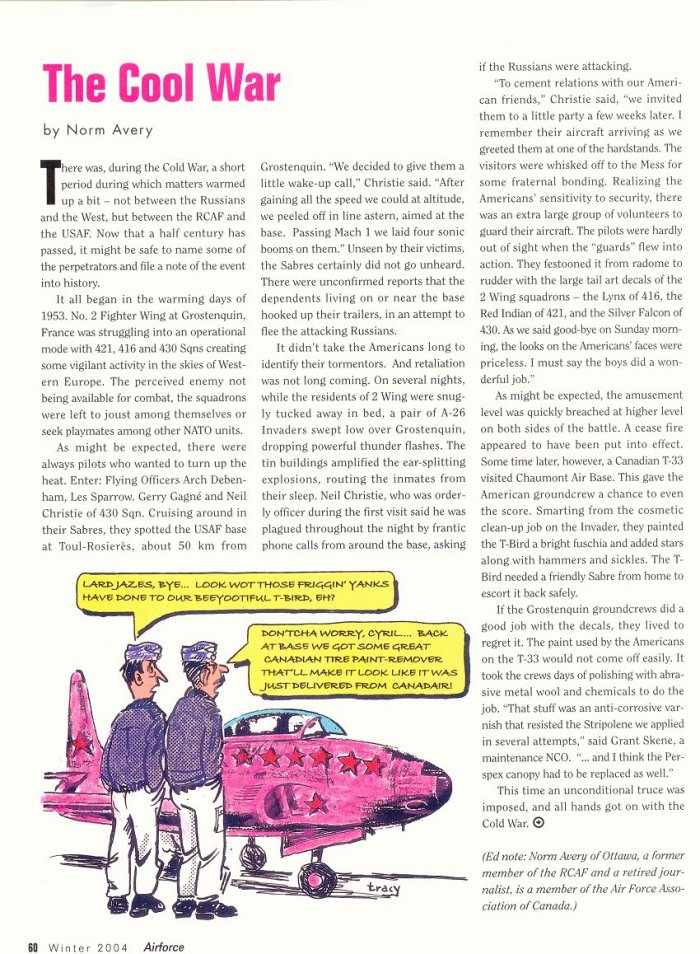
Only the next day did I discover why I had been directed into a secure area, well hidden from the base complex. It seems that the USAF had done some detailed planning on how to “one up” the RCAF following our winter thrash. The idea was to swap a J47 from one of their F-86Fs for an Orenda from one of our Mark 5s. Apparently engine mounts etc. were similar, and the USAF was prepared for whatever adjustments were necessary. So, with a crew of high-priced technicians standing by and no RCAF Sabres, their plan went down the drain. Instead they decided on a lesser scheme – to repaint my T-33. This was beautifully accomplished in US Navy blue, complete with all the detailed decals. Tip tanks, and speed breaks were done in pink, with the Russian hammer and sickle emblem on each wing tip.
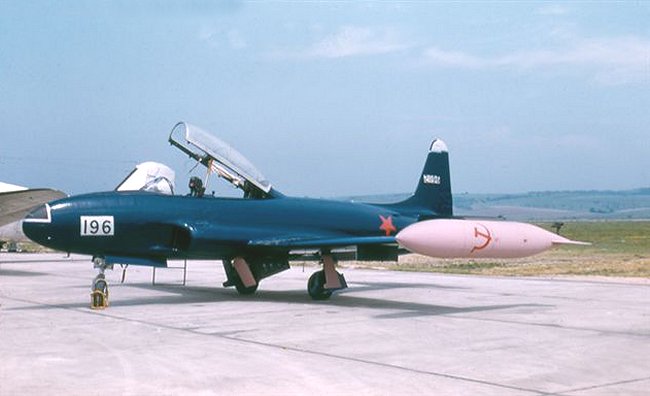
Photo: The “Pink T-Bird” on the ramp at Grostenquin – Courtesy Barney Beaulieu.
“My recollections of the Friday night bash are somewhat vague, but of course it had all the ingredients popular for the time. Next morning, I recall clearly walking across the barren sandy area between the officer’s club and the dispersal and noticing this beautifully painted aircraft. I didn’t recognize it as my own T-33 until quite close, and then “the lights went on!” First I assumed that this was a quick water-colour job that could soon be scrubbed off. But not so. It was good old enamel and quite permanent. Nonetheless, we prepared to depart. The USAF CO was Major Bill Dillard, leader of the Sky Blazers, the USAF’s European aerobatic team. One of his pilots, John Reynolds, suggested that they could wind up three of the Sky Blazers to escort me home, lest some over-zealous NATO pilot spot our Russian markings and shoot us down! The escort was organized in great style, regardless of the fact that they were on UHF and I was on VHF, so we were unable to communicate.
We lined up on the runway in a diamond shape – true aerobatic style. The tower advised us to take off singly, but as I let the speed breaks go the three Sabres followed. They were superb formation pilots, so Tex and I got quite a thrill leading our own aerobatic team! We had one incident on the way home when a nosey stranger tried getting too close. He was soon sent on his way by two of our Sabres. On arrival at Grostenquin, with hand signals, gut feel and whatever else we did, we completed a reasonable beat-up. I then landed, and my escort went home.
The sequel was not quite as pleasant as it might have been. Not only was I in deep shit with G/C Wieser for daring to take a T-33 for the weekend, but I had brought it home as unfit to operate. Come Monday morning the T-bird was back to its original shape, courtesy of a delighted squadron. The fellows enjoyed the incident so much that stripping all the paint off, then repainting the T-33 was easily worth all the trouble.”
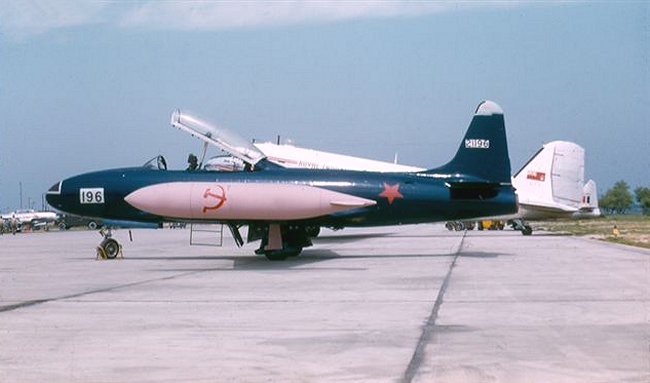
Photo: The “Pink T-Bird” on the ramp at Grostenquin – Courtesy Barney Beaulieu.
Note: Story originaly published bij the Military Communications And Electronics Museum, Kingston, Canada.
More to this story in the article The Cool War aviation journalist Norm Avery, which was piublished in the Winter edition of Airforce.