
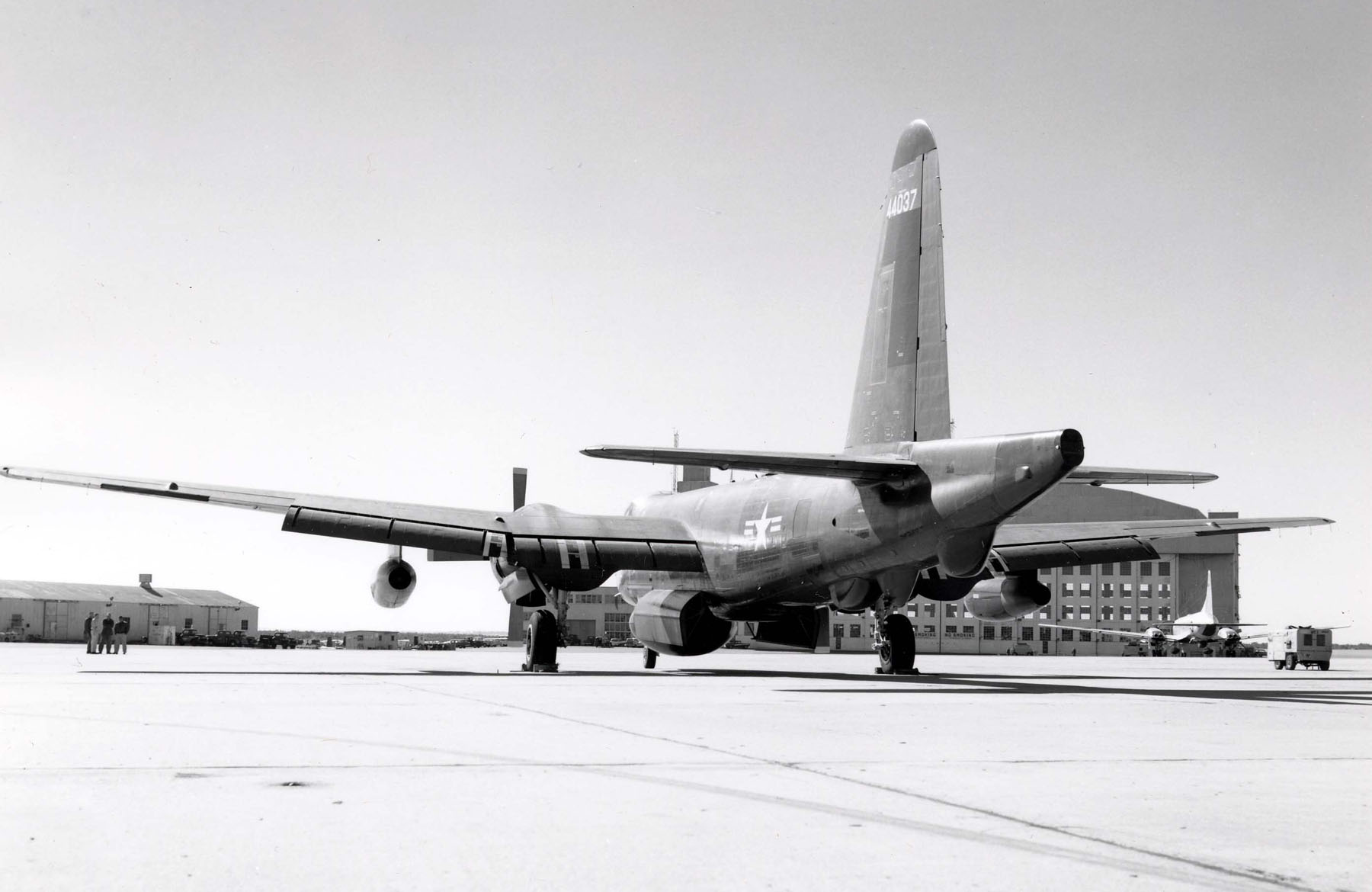
In 1954, the CIA procured seven modified P2V Neptune antisubmarine aircraft for ELINT missions across Europe, Japan, and Taiwan. Under the guise of RB-69 in USAF colors two planes (serials 54-4038 and 54-4039) were sent to Wiesbaden for test and evaluation in the spring of 1957. In the summer of 1957, they were replaced by 54-4040 and 54-4041.
Their deployment occurred in May and June 1957, positioned as Flight D within the 7405th Special Squadron, at least on record. While these aircraft were versatile spy planes equipped with advanced technological apparatus developed at the renowned Skunk Works in Burbank, California, the official description dubbed the blue-black RB-69s as “radio trainers.” They possessed intricate equipment for electronic intelligence border surveillance tasks. It is reported that the RB-69s at Wiesbaden featured tube-like antennas on either side of the fuselage, likely an early iteration of Side Looking Airborne Radar (SLAR). These planes also boasted an innovative and highly effective leaflet dispersal system. Moreover, the aircraft were designed to drop supplies or personnel through a specialized hatch cut into the aircraft’s underside. This hatch could be opened during flight for this specific purpose. Notably, this feature was intended for utilization over Eastern Bloc territories rather than friendly regions.
Project Ostiary
At Wiesbaden, the CIA’s Air Division of DD/P (Department of the Deputy Director of Plans) trained foreign pilots, including displaced persons and repatriated refugees passing through German military processing centers. Czech and Polish airmen, some of whom were drawn from a significant pool of veterans in England who had escaped from Poland during WWII, were assigned to a staging base operated by the CIA in Athens, Greece, likely Elefsis. From here, they flew missions with 7499th RB-26 aircraft, engaging in leaflet drops over Albania, Bulgaria, and Hungary. Encouraged by the outcomes, the CIA once again turned to stateless Poles in 1957 when crews were required for a covert operation involving two Lockheed RB-69A (P2V-7U) Neptunes, which were on loan from the U.S. Navy.
Under the code name Project Ostiary, these crews conducted clandistine missions along and within the Eastern Bloc, based out of Wiesbaden, Germany.