
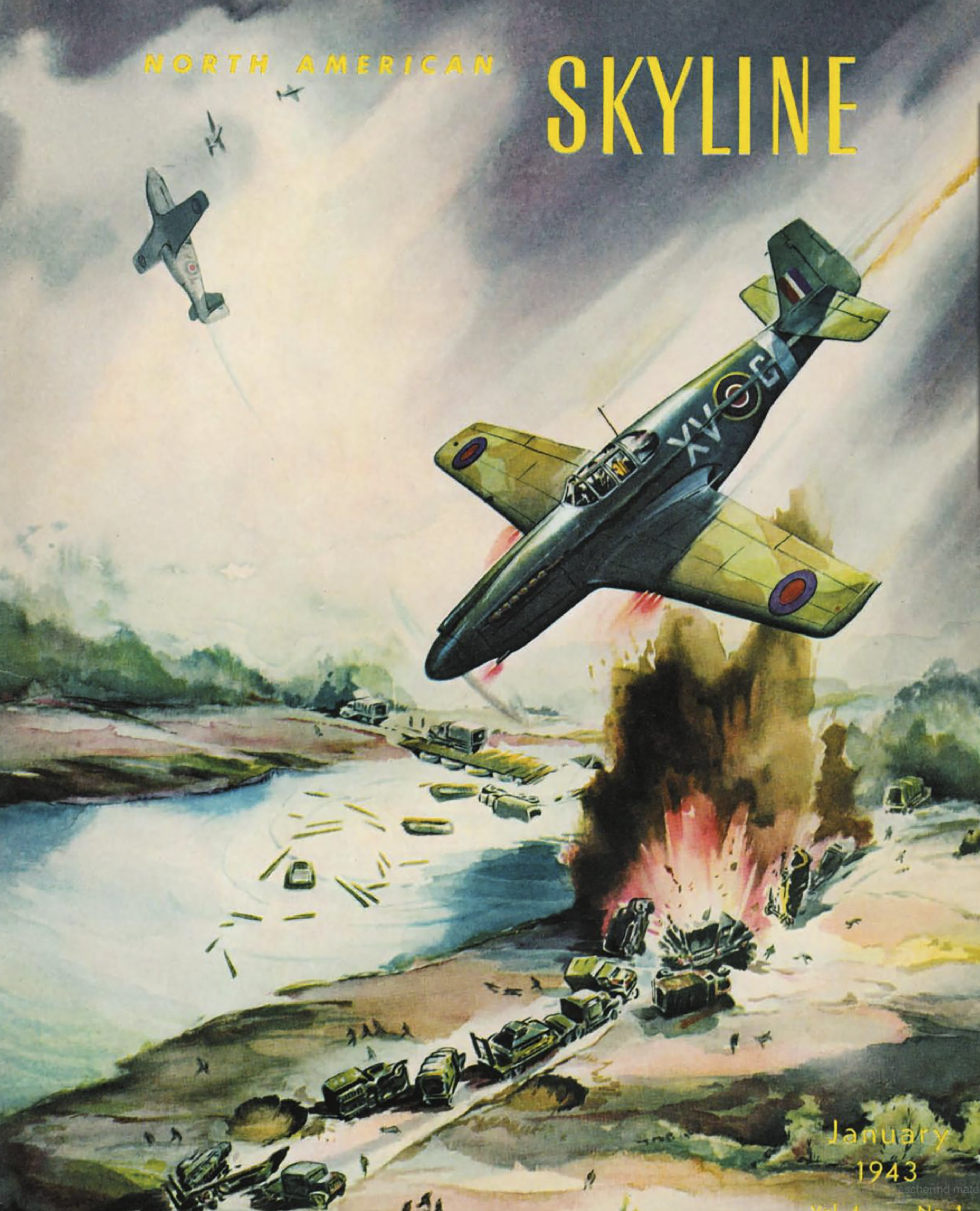
On May 10, 1942, the legendary North American Mustang received its baptism of fire when Flight Officer G.N. Dawson of No. 26 Squadron RAF took several parked Luftwaffe fighters under fire during a reconnaissance flight in Mustang AG418 at Berck-sur-Mer airfield in France. The first Mustang lost in such a reconnaissance flight was AG415, flown on July 14, 1942, by Pilot Officer Henry Taylor, also of No. 26 Squadron RAF.
It attacked ships on the Canche near Étaples. Reportingly, he hit a barge and crashed near Le Tourquet. Wednesday, August 19, 1942, was the day the Mustang scored the first aerial victory in its illustrious career during World War II. 27-year-old American pilot Flying Officer Hollis H. Hills, who flew in Canadian service, had the honor. Hollis was from South Pasadena, Los Angeles, California, near Inglewood, where his Mustang Mk.1 AG470 with the fuselage code RU-M came from. He volunteered for the Canadian Forces in Toronto in September 1940, attended pilot training, and was assigned to No. 400 Squadron (RCAF) at RAF Gatwick. On August 19, 1942, his squadron acted and conducted reconnaissance flights supporting Operation Jubilee. In this British/Canadian attempt to form an Allied bridgehead near Dieppe, Hills flew over the battlefield early in the morning with his flight leader, Flight Lieutenant Fred Clark. In the afternoon, they prepared for their second sortie that day. They flew low over The Channel toward Dieppe, where they were tasked with observing military troop movements. Once they arrived over the area south of Dieppe, they were suddenly jumped by three Fw 190s from one of the two Jagdgeschwader (JG 2 and JG 26) operating in the Channel Zone in 1942. In Mustang AG375 RU-F, Clark was surprised and shot at, forcing a crash landing on the water. Hollis Hill could maneuver his Mustang into a good position, bringing down an Fw 190. It was the first aerial victory of a Mustang in European combat.
Returning to U.S. service, Hollis became a Brewster Buffalo instructor in Florida. Later, flying a Grumman Hellcat with VF-32, he scored four more air-to-air victories (Zeroes) in the Pacific Theater, plus another probable and two planes destroyed on the ground.
Illustration: Cover ‘North American Skyline’, January 1943.