
In recent years, Greenland’s strategic value has been underscored by geopolitical developments. The Arctic is becoming increasingly accessible due to climate change, leading to new navigation routes and resource exploration opportunities. Greenland’s location provides a vantage point for monitoring Arctic activities, including those of Russia and China, which have expressed interest in expanding their presence in the region. The U.S. views Greenland as crucial to countering these influences and ensuring freedom of navigation in the Arctic.
U.S. interest in Greenland is not new. In 1946, the United States offered Denmark $100 million in gold to buy Greenland, aiming to monitor Soviet activities in the Arctic during the early stages of the Cold War. Denmark rejected the offer, but the U.S. continued to seek ways to establish a military presence on the island.
During World War II, after Germany occupied Denmark, the United States, invoking the Monroe Doctrine, established a military presence in Greenland to prevent the island from being used by the Axis powers. This move underscored Greenland’s strategic location in the North Atlantic, serving as a critical point for air and sea routes between North America and Europe. During that time, the U.S. constructed the “Bluie” staging bases that served as stopovers for planes en route to Europe, including Bluie West One (BW-1) near Narsarsuaq, Bluie West Eight (BW-8), the present-day airport of Kangerlussuaq, and Bluie East Two (BE-2) near Ikateq.
In the Cold War era, Greenland’s importance increased due to its strategic location relative to the Soviet Union. The U.S. established Thule Air Base in northern Greenland, which became central for missile warning systems and strategic air operations. During the 1950s and 1960s, Thule Air Base was integral to the Strategic Air Command’s (SAC) operations. Its Arctic location allowed U.S. bombers to approach the Soviet Union over the polar ice cap, reducing early warning times. The base served as a forward staging point for B-36 Peacemaker and B-47 Stratojet aircraft, facilitating rapid deployment and extended reach during the Cold War. The base also served as an operations center for nuclear bombers as part of the Chrome Dome program. Chrome Dome was the United States Air Force’s (USAF) initiative during the Cold War, running from 1961 to 1968, aimed at maintaining a continuous airborne alert with nuclear-armed B-52 Stratofortress bombers. Under this operation B-52 bombers flew predetermined routes that brought them within striking distance of key targets in the Soviet Union. These routes typically included the Northern Route: departing from bases in the United States, aircraft would fly over the Canadian Arctic, proceed towards Greenland, and then return via Alaska. An accident in January 1968 involving a B-52G with four thermonuclear bombs, known as the Thule incident, led to significant radioactive contamination and marked the end of Chrome Dome. A 1995 investigation that showed the government had implicitly approved the presence of nuclear weapons in Greenland, in violation of Denmark’s 1957 nuclear-free zone policy, sparked a political storm in the country.
Thule Air Base is now known as Pituffik Space Base. The base is operated by the 821st Space Base Group and supports missile warning, missile defense, and space surveillance missions in the Arctic. A key component of the Pituffik Space Base is the Upgraded Early Warning Radar (UEWR), formerly known as the Ballistic Missile Early Warning System (BMEWS) Site 1. Operated by the 12th Space Warning Squadron, the UEWR is operational 24/7 and provides early warning of Russian ballistic missile launches to national command authorities through the Missile Warning Center and North American Aerospace Defense Command (NORAD). The radar system is part of a global network that detects and tracks missile launches and objects in space, contributing to the defense of the U.S. and NATO countries.
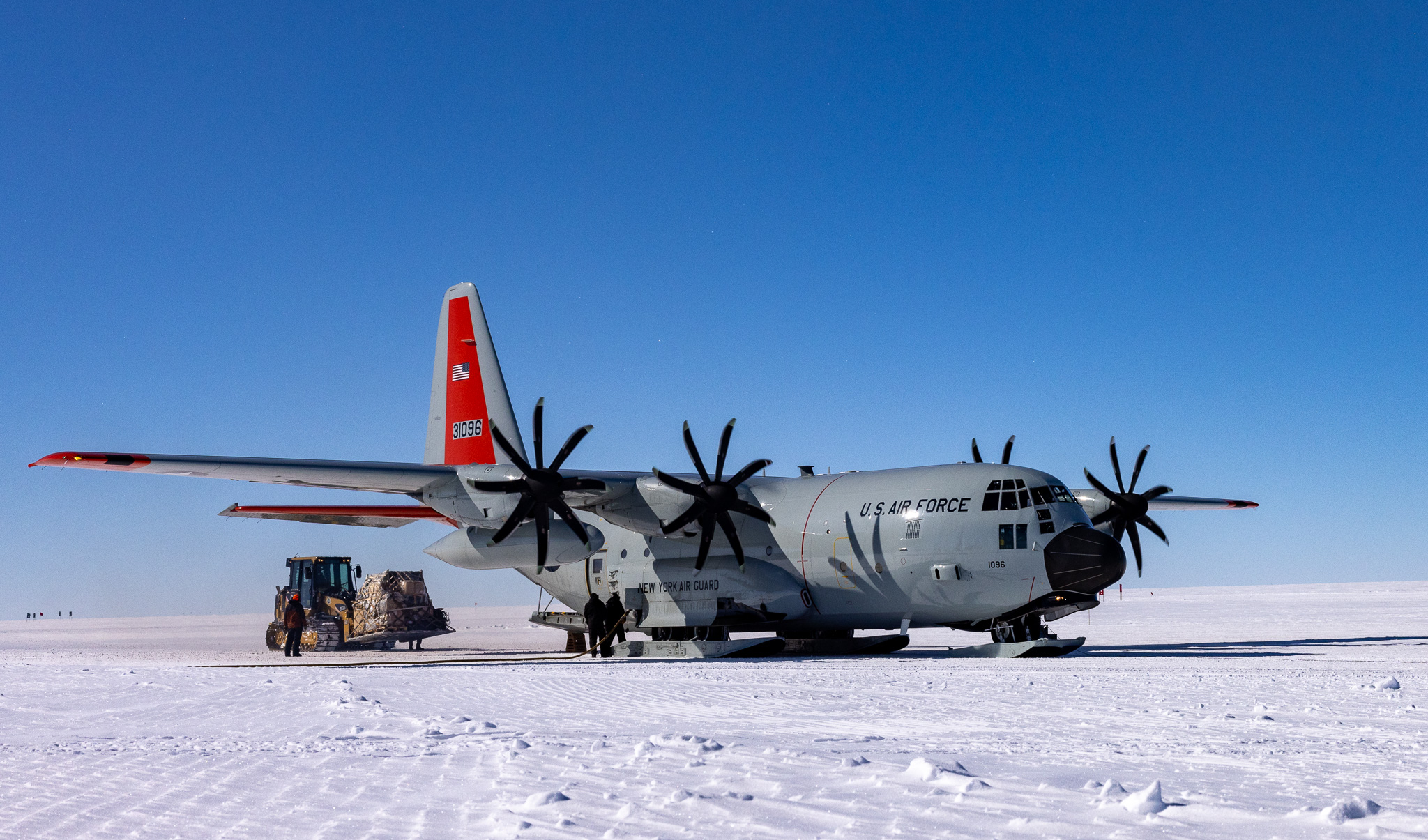
Photo: An LC-130 Hercules aircraft from the 109th Airlift Wing is being unloaded at Summit Station, Greenland, May 9, 2024. Summit Station is ideal for studying long-range intercontinental transport and its effects on the ice sheet surface. (U.S. Air National Guard photo by Senior Airman Jocelyn Tuller)